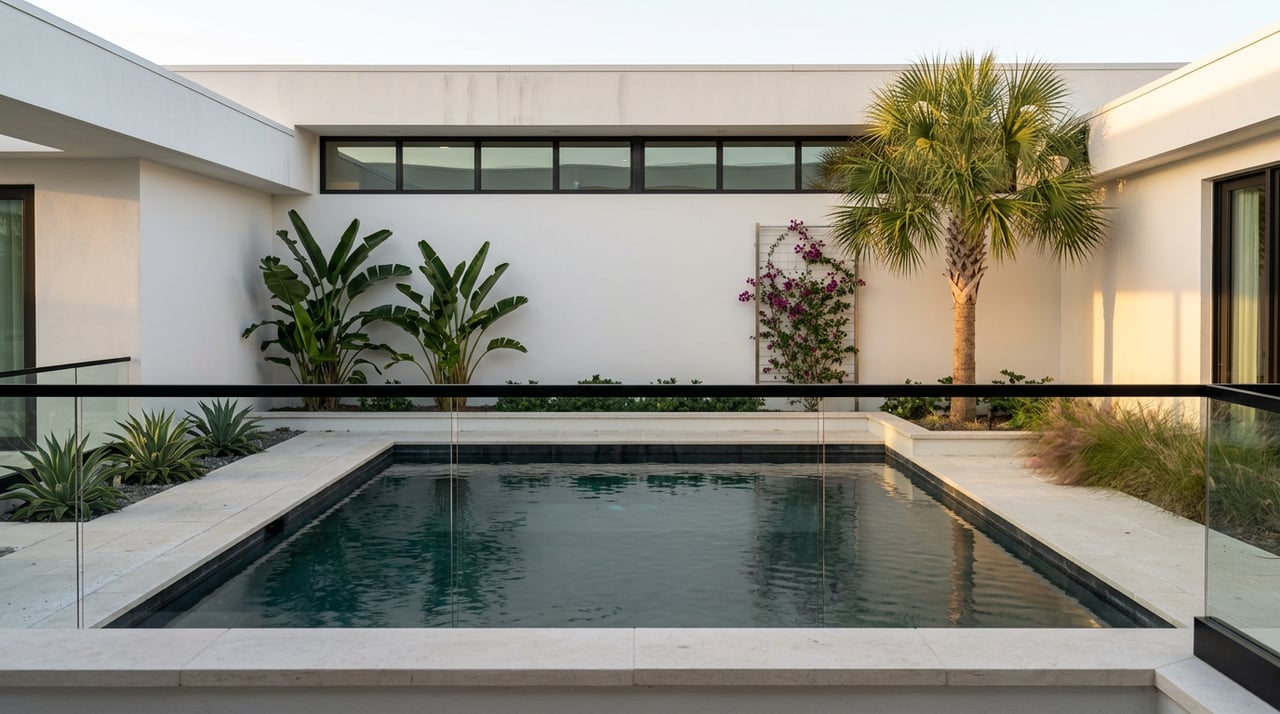
What Casey Key's "Land For Sale" Listings Are Actually Selling You
September 10, 2026
September 10, 2026
"Milton took off half the roof."
That's how one longtime Casey Key real estate agent described the end of the house that used to sit at 608 N. Casey Key Road, a cottage built in 1918 that had outlasted a century of Gulf storms before Hurricane Milton finished the job in October 2024. It came down not long after. On an island where the oldest surviving structure was demolished within the last two years, the question a buyer needs to ask about any listing isn't just "what does this cost." It's "what, exactly, am I buying."
That question matters more on Casey Key than almost anywhere else on the Gulf Coast, because the answer is rarely the one the listing photos suggest.
Casey Key is an eight-mile barrier island reached by a swing bridge dating to the 1920s at its north end and a second bridge connecting the south end to the mainland, with fewer than 500 properties total and a deed-restricted residential covenant that has held since the 1950s. That combination means new buildable land essentially doesn't get created here. It only gets recycled.
So when a listing on Casey Key is marketed as "land," it is almost never a genuinely vacant parcel. It's a structure, usually storm-damaged or simply outdated, priced at what the dirt underneath it is worth. As of late June 2026, active land inventory on the island consisted of a single listing at a median ask of $1,350,000. That scarcity is the point. A buyer chasing a blank canvas on Casey Key is more likely to end up chasing a demolition permit.
The distinction isn't cosmetic. A true teardown-and-rebuild carries its own runway: months of design and permitting followed by roughly 9 to 14 months of vertical construction, meaning a buyer who closes today is realistically a year or more from a certificate of occupancy. Some of these lots still carry useful infrastructure, an existing seawall or septic system, that a truly raw parcel wouldn't have. Others don't. Neither fact shows up in the list price.
| Metric | Figure |
|---|---|
| Median sold price (12 months ending Aug. 2, 2026) | $3,250,000 (up 18.2% year over year) |
| Median days to sale (12 months ending Aug. 2, 2026) | 170 |
| Sale-to-list ratio (12 months ending Aug. 2, 2026) | 83.6% of original asking price |
| Share of closings paid in cash (12 months ending June 2026) | 95% |
| Listings withdrawn or expired unsold (year-to-date 2026) | 45% |
Two of those numbers, taken together, tell a story the median price alone doesn't. A market where the typical seller accepts 84 cents on the asking dollar, and nearly half of all listings never sell at all, is not a market where "comparable sales" mean much. It's a market where two homes at the same price point can represent two entirely different financial products.
The mechanism that produces this split is the National Flood Insurance Program's substantial improvement rule, generally known as the 50% rule: if the cost of repairing or improving a structure reaches half of its market value, the entire building must be brought up to current flood elevation standards, not just the damaged portion. That's the federal floor. What most buyers don't realize is that it's only a floor. Sarasota's barrier island towns each write their own version of the rule on top of it.
Longboat Key's own code, for example, defines substantial damage as repair costs equal to half the structure's market value and requires elevating to base flood elevation plus one foot townwide, and up to plus five feet in the lowest-lying areas. That's one island's answer. Nearby jurisdictions answer the same federal question differently, particularly on the detail that matters most in a slow-moving rebuild market: the lookback window. Some count only the current project against the 50% threshold. Others accumulate every permit pulled over several years, which means a new owner can unknowingly inherit a prior owner's renovation history and find themselves halfway to a forced elevation before they've done any work at all.
There's also a myth worth retiring here. The assumption that every Gulf Coast town tightened its substantial-improvement rule after Hurricane Milton doesn't hold up against what's actually written into the ordinances. Some places moved. Others didn't. The only way to know which one applies to a specific Casey Key parcel is to pull the property's permit history and ask the county directly, before writing an offer, not after.
As one Washington Post account of the storms' aftermath put it, the real question facing barrier island owners wasn't whether to fix the damage. It was whether to rebuild at all, or give in to what the climate keeps sending their way.
That uncertainty is a big part of why 95% of recorded Casey Key closings in the 12 months through June 2026 were paid in cash. It isn't simply that buyers here have the means. It's that financing a home with an uncertain elevation status is genuinely harder. Flood insurance premiums are recalculated for each new owner under FEMA's Risk Rating 2.0, which means a buyer cannot assume the prior owner's policy price will carry over. A quote can arrive nearly triple what a seller was paying, and when that happens close to closing, it can push a buyer's true monthly payment past what a lender's debt-to-income limits allow.
Cash sidesteps that entire negotiation. It's also why cash buyers, not mortgage buyers, are the ones setting the market's real pace on Casey Key.
A 45% withdrawal rate in 2026, on an island whose own long-run average sits closer to 67%, is not actually the improvement it looks like at first glance. It still means close to half of everything listed this year came off the market unsold. On a barrier island with a ten-year average of roughly ten sales a year, that's a market where sellers are frequently pricing the wrong asset, marketing a house's finishes when the real value driver is the lot's redevelopment certainty, or marketing a lot's scarcity while ignoring that its 50%-rule exposure makes rebuilding far more expensive than a buyer assumed.
Overpricing against the wrong comparable set is the most common reason a Casey Key listing goes stale. A home priced off recent estate sales elsewhere on the island, without adjusting for Gulf versus bay frontage or for a structure's actual substantial-damage status, is set up to sit.
A short list of the questions worth settling before a contract, not after:
Is it possible to find a genuinely vacant lot on Casey Key? Rarely. Because the island is fully built out under a covenant dating to the 1950s, nearly all "land" inventory is a structure priced at lot value rather than raw acreage.
Does paying cash mean a buyer can skip the flood insurance conversation? No. Lenders may not require it, but any owner in a high-hazard flood zone is exposed to the same rebuild costs and the same 50% rule regardless of how the purchase was financed.
If a home hasn't been renovated recently, is it safe from the 50% rule? Not necessarily. Storm damage counts too. A structure that suffered damage from Helene or Milton and was repaired without a full permit review may already be closer to the threshold than its listing suggests.
Casey Key rewards buyers who do the diligence a median price can't do for them. If you're comparing this island against others on the Gulf Coast and want a clear read on what a specific parcel's rebuild math actually looks like, Cindy Fischer can walk through the permit history, the jurisdiction's specific rule, and what it means for your offer. Let's Connect.
Stay up to date on the latest real estate trends.
Whether buying or selling, Cindy's attention to detail and extensive knowledge of Longboat Key makes her the perfect choice to fulfill your real estate needs.