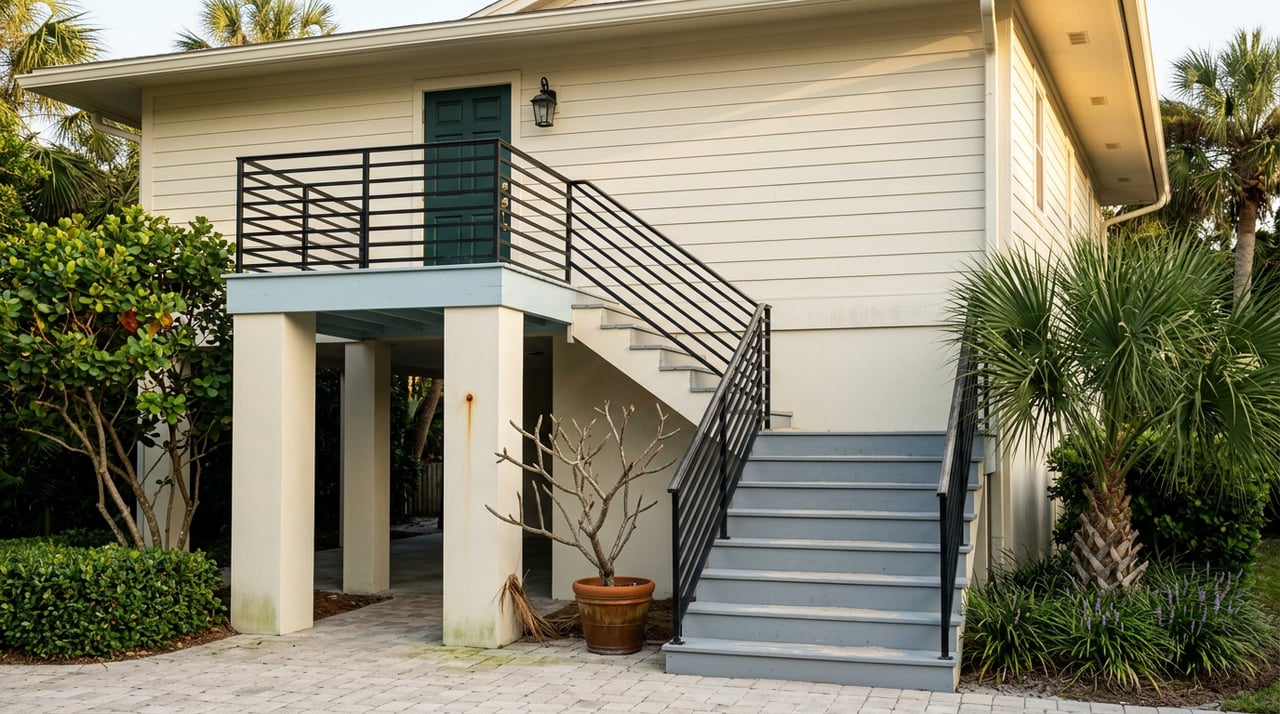
The Elevation Paradox Behind Every Older Longboat Key Sale
September 3, 2026
September 3, 2026
On June 22, the Longboat Key Town Commission sat down for what was billed as a routine workshop and ended up admitting something most sellers on the island don't know yet. The Town wants more homes raised above flood level. The Town's own zoning code makes that hard to do on exactly the lots where it matters most.
Town Manager Howard Tipton opened the session by telling commissioners this would be one of the more interesting conversations they'd have all year. He wasn't wrong. What followed was an hour of staff and elected officials working through a contradiction that has real consequences for anyone who owns, or is about to buy, an older home on a smaller Longboat Key lot.
The workshop wasn't a vote. It was staff and commissioners naming a problem out loud: when a homeowner tries to lift an aging, flood-prone house to meet current federal standards, the Town's zoning code often stands in the way. Setback rules, daylight plane requirements, and lot coverage limits were written for houses sitting at grade. They don't always leave room for a house that needs to sit several feet higher.
Allen Parsons, the Town's Planning, Zoning and Building Director, laid out the practical version of the problem. Homeowners who've experienced flooding and want to invest in raising their homes are running into regulatory friction on exactly the smallest, most constrained lots. Commissioner Sarah Karon raised the other side of it too: neighbors who don't raise their homes sometimes feel that a raised house next door changes their light, their privacy, or their property value, which means every exception granted for one owner creates friction with another.
Commissioner Bishop put the long-term trajectory in blunt terms:
"As much as I hate seeing those neighborhoods become mega-mansion neighborhoods with elevated homes, the reality is that's probably what Longboat Key in the next 10 to 20 years is going to look like."
That's not a prediction from a real estate blog. That's a Town official saying it at a public meeting. It matters because it tells you where the island's older housing stock is headed, and it tells you which properties are going to have an easier or harder time getting there.
FEMA's substantial improvement rule, sometimes called the 50 percent rule, is the mechanism behind all of this. If the cost to repair or improve a structure reaches half of its market value, the entire structure has to be brought up to current flood code, not just the portion being repaired. A $400,000 structure can absorb roughly $199,000 in work before that threshold flips. Cross it, and you're not patching a roof anymore. You're rebuilding to current Base Flood Elevation standards, full stop.
On Longboat Key, most of the island sits inside FEMA's AE and VE flood zones, with VE carrying the highest premiums because it accounts for wave action on top of standing water. New residential construction in A-zones must sit at least one foot above Base Flood Elevation under Town rules, and anything in a V-zone or seaward of the coastal construction control line has to clear three feet above BFE. Those are the Town's own standards, stricter than the federal floor.
Here's the part that doesn't show up on a listing sheet. The homes most likely to trip the 50 percent rule after a storm, and therefore need to raise, tend to be the same homes sitting on the smaller, older lots where the daylight plane and setback rules leave the least room to do it. A newer home on a larger parcel in Bay Isles or Country Club Shores rarely faces this fight. An older cottage on a narrow, mid-island canal lot is exactly the property the Commission was talking about.
There's also a county line running through the middle of the island. The northern third sits in Manatee County, the southern two thirds in Sarasota County, and each county runs its own permitting timelines and flood standards. A buyer comparing two similar-looking homes on either side of that line is comparing two different regulatory paths, not just two different tax bills.
The dollar difference between a well-documented, properly elevated home and one without current paperwork is not small. Here's roughly how it breaks down for a mid-tier Longboat Key home in 2026, based on the ranges currently quoted by Florida coastal insurers.
| Scenario | Annual flood + wind premium (approx.) |
|---|---|
| Finished floor well above BFE, current elevation certificate on file | $10,000–$18,000 |
| Older home at or near BFE, no certificate on file | $20,000–$30,000+ |
| VE zone, older construction, no wind mitigation report | Can exceed $40,000 |
The swing between the top and bottom rows of that table is bigger than most buyers budget for, and it's driven almost entirely by two documents: the elevation certificate and the wind mitigation report. The Town's own Flood Risk & Elevation Certificate Search, built on the Forerunner platform, lets anyone pull a property's flood zone, Base Flood Elevation, Design Flood Elevation, and any elevation certificates already on file, searchable by address, before a contract is ever written. It costs nothing to check. Skipping that step is the single most common way buyers get an unpleasant surprise at the insurance quote stage rather than the offer stage.
Until October 2024, Florida sellers had only a general obligation under case law to disclose material defects that weren't readily observable. That changed with a new statute, Florida Statute 689.302, which requires a standalone written flood disclosure delivered at or before the sales contract is signed. The original version covered two things: whether the seller had filed a flood insurance claim, and whether they'd received federal disaster assistance for flood damage.
Effective October 1, 2025, the Legislature expanded that requirement. Sellers now have to disclose any flooding that damaged the property during their ownership, whether or not a claim was ever filed. The federal-source requirement for assistance was also removed, so any assistance received to fix flood damage now counts. The expansion reaches further than residential sales too, now covering condo developers and landlords on leases of a year or longer.
For a Longboat Key seller with an older home, this isn't a form to skim. If the house ever took on water, even without a formal claim, that history now has to be in writing before the buyer signs. Pair that with the substantial damage question sitting underneath any elevation conversation, and a seller who hasn't pulled their own elevation certificate and flood history is walking into a negotiation with less information than the buyer's inspector will eventually have.
A few steps are worth taking before either side commits to a contract:
None of this replaces legal or insurance advice specific to a given property. It's simply the order of operations that keeps a transaction from stalling at the inspection or insurance stage.
The Commission's own read on the island's future is that more homes will end up raised, whether by choice or by storm. That means the gap between properties with clean elevation paperwork and properties without it is going to widen, not narrow. A home that can prove its finished floor sits comfortably above Base Flood Elevation will keep insuring, financing, and selling more easily than a comparable home without that documentation, even if the two look identical from the street.
For sellers, that argues for getting the elevation certificate and flood disclosure sorted before the sign goes in the yard. For buyers, it argues for treating that paperwork as seriously as the inspection report. The zoning fight the Town is having with itself will take years to resolve. The documentation gap it's exposing doesn't have to wait that long to matter for your transaction.
Does the 50 percent rule apply to condos the same way it applies to single-family homes? The rule applies to the structure, so for a condo building it's typically assessed at the building level rather than per unit, which is a separate conversation from the flood disclosure obligation that applies to the individual seller.
Is the flood disclosure required even in an as-is sale? Yes. The flood disclosure under Florida Statute 689.302 is a separate statutory requirement from the standard property disclosure, and an as-is contract doesn't remove it.
Does an elevation certificate expire? There's no blanket expiration date, but if a property has been altered, regraded, or had flood maps updated since the certificate was issued, a current one is worth ordering rather than relying on an older document on file with the Town.
If you're weighing a sale on an older Longboat Key property, or trying to evaluate one before you write an offer, this is exactly the kind of detail worth getting right before it becomes a problem at the closing table. I'd welcome the chance to walk through your specific parcel, its flood zone, and what the paperwork actually says. Let's Connect.
Stay up to date on the latest real estate trends.




Whether buying or selling, Cindy's attention to detail and extensive knowledge of Longboat Key makes her the perfect choice to fulfill your real estate needs.